Gene Therapy for Parkinson’s Disease
Gene therapy is a group of treatment methods that involve introducing modified DNA into specific cells of a diseased organism to alter the proteins produced (and improve symptoms) or even cure the disease.
For decades, researchers have been trying to improve gene therapy for various diseases. Success has been achieved with some rare genetic disorders (e.g., SMA), where the cause of the disease is a single, well-known mutation in a specific gene. In such cases, a healthy gene is introduced into the cells of these patients, and the patient recovers.
It is much more difficult to create gene therapy for diseases associated with more complex and multifactorial DNA changes. For example, in Parkinson’s disease.
How does gene therapy work
Virus – a tiny piece of nucleic acid capable of penetrating a cell and “enslaving” the cell’s mechanism to reproduce its own nucleic acid and produce viral proteins, often causing diseases in the process. Some viruses can even insert their own genetic material into the genetic material of the cell they infect. Scientists have now learned to use these processes for gene therapy. Harmful pieces of DNA are removed from the virus, and a selected gene is incorporated into the viral structure. The modified virus is then introduced into a specific part of the body, allowing it to “Infect ” cells. If all goes according to plan, the piece of DNA that was inserted into the modified virus is used by the cell’s mechanisms to create the necessary proteins
One of the most challenging aspects in this field remains the safe delivery of the viral “medicine” to the brain through the blood-brain barrier in neurological diseases (Parkinson’s disease, Alzheimer’s disease)
Breakthrough in Gene Therapy
Results of the preclinical study conducted by the Foundation under the guidance of Prof. Jose Obeso have been obtained HM CINAC, Madrid, Spain). Researchers used the focused ultrasound technique with microbubble technology for the safe and effective delivery of gene therapy across the blood-brain barrier in areas of the brain affected by synucleinopathy (Parkinson’s disease)
Gene therapy has incredible potential for treating Parkinson’s disease because it can be used in three different ways:
- to slow down the neurodegenerative process
- for the restoration of already damaged neurons
- to protect “pure,” undamaged neurons
Researchers have proven that they were able to deliver modified adeno-associated viral vectors to the basal ganglia of the brain in six primates using MRgFUS and microbubbles. To open the blood-brain barrier, low-intensity pulsed sound exposure was used three to four minutes after the introduction of microbubbles. Vectors AAV9 were administered intravenously after opening the BBB
The technique was recognized as safe and well-tolerated by primates. The BBB was temporarily opened (it was closed after the procedure). Delivery of proteins marked with vectors AAV9, was performed in the target areas of the brain
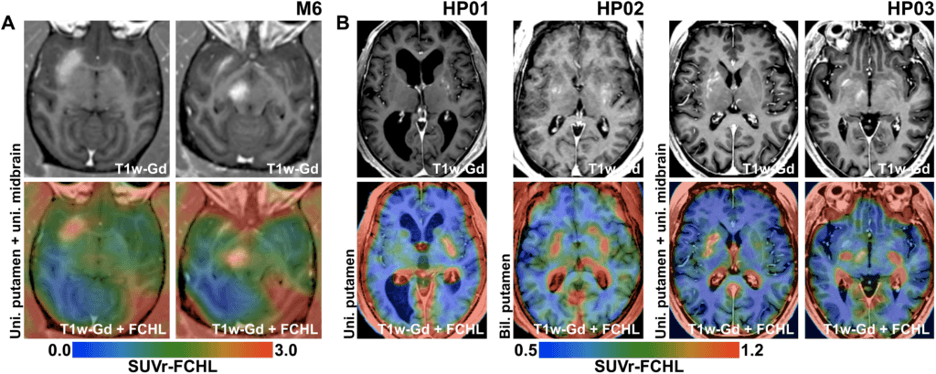
In vivo PET imaging of permeability BBB using 18F-holine at NHP and patients with PD
Source: Javier Blesa et al., Discovery BBB focused ultrasound in non-human primates and patients with Parkinson’s disease: targeted vector delivery AAV. Adv.9,eadf4888 (2023). DOI: 10.1126/sciadv.adf4888